Frozen Pipes in a Yakima or Kittitas Winter: The First Ten Minutes
Most frozen pipes can be dealt with safely in ten minutes, if you know what to do and what to leave alone.
October 7, 2026 · 4 min read
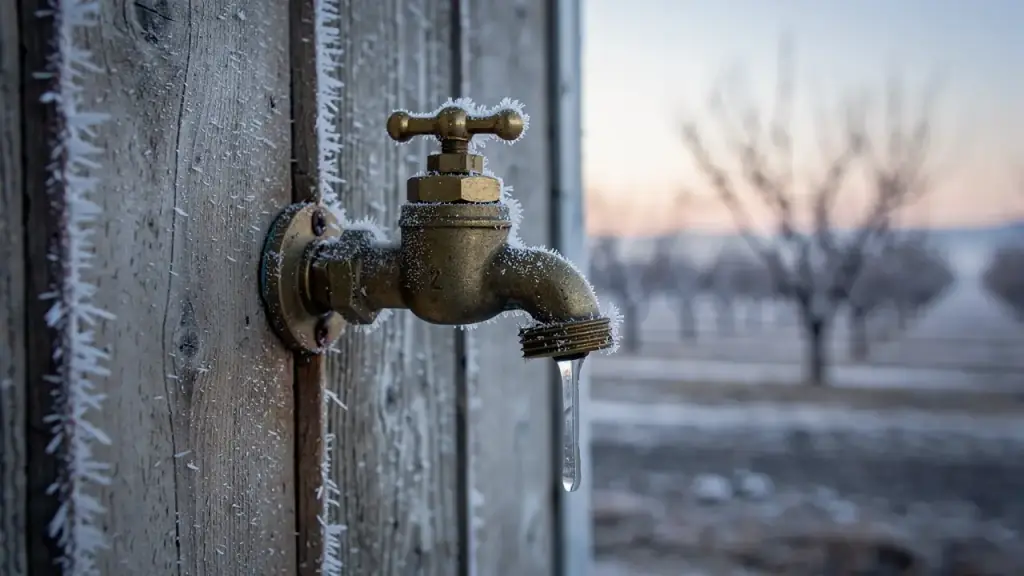
A hard freeze in the Yakima Valley does not announce itself. You go to bed with a quiet kitchen and a hose still hooked to the side of the house, and you wake up to a faucet that coughs and gives you nothing. Up in Ellensburg and Cle Elum the cold settles in earlier and stays longer, but Selah, Naches, Sunnyside and Wapato get plenty of nights cold enough to stop water in a line. Here is what to do in the first ten minutes, and the point where you should put the tools down and call a plumber.
Minute one: find out what you are dealing with
Turn on the hot and cold taps in the kitchen and a bathroom. If nothing comes out, or only a thin trickle, you probably have ice somewhere in the line. Check whether the whole house is affected or just one fixture. A single dead tap usually points to a frozen branch line near an exterior wall. Every tap dead points toward the main line or the area where water enters the house. Then look for the obvious: water on the floor, a stained ceiling, a wet crawlspace hatch, or the sound of running water when everything is off. A pipe that has already split can look like nothing at all while it is frozen. The trouble starts when it thaws and the water arrives all at once.
Minutes two through ten
- Find your main shutoff valve and make sure it turns. If you see water where water should not be, shut the main off right away. If you do not know where the valve is, find it today, before you need it.
- Open the tap closest to the frozen section, cold side first. As the ice melts the water needs somewhere to go, and an open tap relieves pressure and tells you the moment flow comes back.
- Warm the pipe slowly. A hair dryer on a low setting, warm towels wrapped around the pipe, or a space heater set well back from anything that can burn will all work. Start at the tap end and move toward the frozen area.
- Open the cabinet doors under sinks on exterior walls so room air can reach the pipes behind them.
- Keep the furnace or boiler running, and warm up the room or crawlspace if you can reach it safely.
- Watch the pipe as it thaws. Any drip, spray or bulge means a split. Shut off the main and make the call.
What not to do
People get hurt and houses get damaged in the rush to thaw a pipe. Never use an open flame, a propane torch or a heat gun turned up high. Copper carries heat down the pipe to places you cannot see, and the old framing around it can catch. Plastic pipe can warp long before metal does. Do not pour boiling water over a pipe, and do not try to thaw a line that is already leaking, because water and electric heaters or hair dryers are a bad pairing. And do not walk away from a pipe that is thawing with the main on and the taps closed. If it has split, that is when it lets go.
Where pipes freeze first in valley homes
The same few places show up again and again in our part of the state. Hose bibs and yard hydrants that still have a hose attached. Pipes running through an unheated crawlspace. Supply lines in an outside wall behind the kitchen sink. Water lines in a garage or a shop. Plumbing under a mobile home. Older farmhouses out past Cowiche and Moxee often have plumbing that was never planned for a hard winter, and an addition built on a slab can put a supply line somewhere with no insulation at all. If a pipe froze once in your house, it will freeze there again, so it is worth fixing the cause and not just thawing the symptom.
Before the next cold snap
- Disconnect garden hoses and drain outdoor spigots before the first freeze.
- Tag your main shutoff so anyone in the house can find it.
- Open the cabinet doors on exterior walls when the forecast drops.
- Let a cold tap drip on the line farthest from where water enters the house during the coldest nights.
- Seal gaps where pipes pass through walls and around crawlspace vents.
- Insulate exposed pipes in crawlspaces, garages and sheds.
- Leave the heat on if you travel, even in a room you rarely use.
When to call, and who answers
Call a plumber if you cannot find the frozen section, if the pipe runs inside a wall or under a slab, if you see any leak at all, if the frozen line is the main, or if ten minutes of careful warming has not brought water back. Central Mechanical Services has a 24/7 emergency line for critical plumbing issues, and freezes do not wait for office hours. The office is open Monday through Friday, 8 to 5, but the emergency line is there for the nights and weekends when pipes tend to give out.
A frozen pipe thawed in time is an inconvenience. A burst one is a repair and a cleanup. If you are not sure which one you have, call Central Mechanical Services at (509) 248-5944.
Central Mechanical Services, (509) 248-5944
Call (509) 248-5944More articles
Gas, Electric, Tankless or Heat Pump: Choosing a Water Heater
The right water heater depends on your house, your fuel and how your family actually uses hot water.
Living With Steam or Hot-Water Radiators in an Older House
Radiator heat is quiet, gentle and long-lived when you understand it, and a little confusing when you do not.